
The largest wooden ship ever built in SC
|
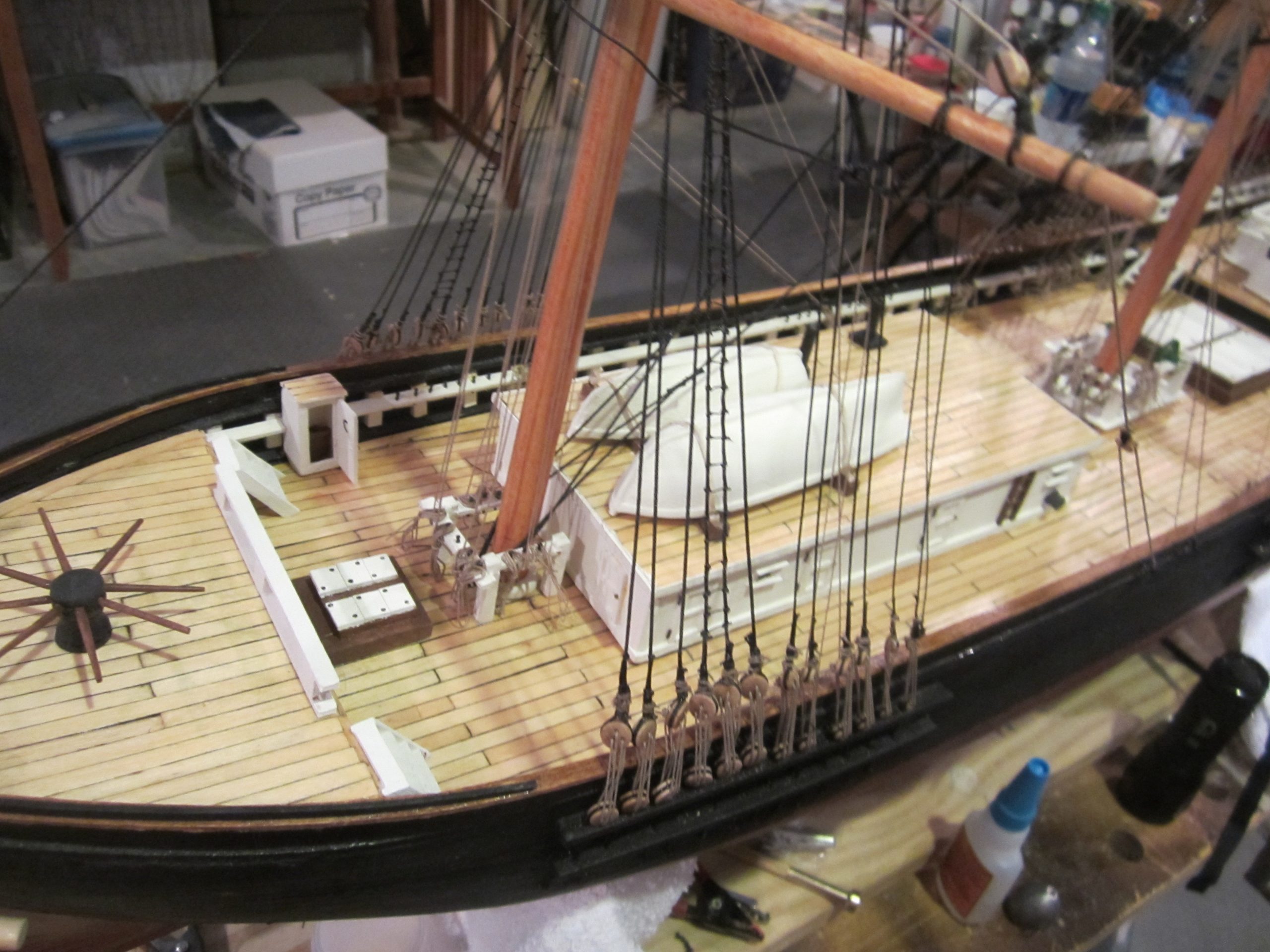
The Henrietta was the largest wooden ship ever built in South Carolina. She was 210 feet long and registered 1267 tons. She was a three-masted clipper ship. The tallest mast towered 147 feet above the deck, and she carried 24 sails. How big is that? The U.S.S. Constitution (“Old Ironsides”), which is still in the service of the U.S. Navy and docked in Boston, was only 175 feet long. The Bohomme Richard, made famous by John Paul Jones (“I have not yet begun to fight”) measured a scant 152 feet. Henrietta was gigantic by comparison. |
|
How was it that the Henrietta was born near Georgetown? It started in Maine. The Bucks were a prominant shipbuilding and lumber family that founded Bucksport, Maine. By the early 1800′s the forests of New England were not depleted but “picked over”, and choice trees were getting hard to find. A young family member, Henry Buck, went forth in the 1820′s on a foraging mission to the South to find new timber sources. On a venture up the Waccamaw River north of Georgetown, Henry began salivating when he saw the cypress swamps and the virgin long leaf pines. To a lumberman, it was a gold strike. He dropped the Buck family anchor on the spot, bought a slave, and got to work. He set up his sawmill on the Waccamaw, and since the Buck family custom was to name towns after themselves, Henry named his new location Bucksville. (later, he built another sawmill downstream and anmed it Bucksport; both these communities still exist in Horry County though lumbering is long gone.) Soon, ships were sailing past Georgetown to Bucksville and loading up with cypress and hard pine. New England shipbuilders were afraid of Carolina pine to begin with, but soon they saw that it was durable planking timber, and Henry Buck helped promote their change of heart. Buck prospered in the mid-1800′sand was reputed to be the richest man in the Horry District. He owned 300 slaves at his pinnacle, an intriguing dissimilarity to his family in Maine. When the guns sounded at Fort Sumter, Buck supported the Confederate cause with his wealth, but he did not want to see a breakup of the Union. His position wa schizophrenic, but his lumber business kept growing nonetheless. |
|
At one time during the second half of the 19th Century, Bucksville was the third largest port in South Carolina, and Buck’s lumber business was the reason. Buck had maintained hi Maine family ties notwithstanding the breach in Civil War sympathies. Since the Maine operations included a sizable shipbuilding enterprise, it began to make sense to build ships in South Carolina, now that Carolina hard pine had proven itself, and the mild climate was inviting compared to the harsh Maine winters. Henry Buck died in 1870, but the decision to build ships in South carolina was taken up by his son, William Buck. Expert shipwrights and millwrights moved down from Maine to Bucksville, and their first construction was a three-masted schooner called the Hattie McGilvery Buck. (There’s that anme again.) Encouraged by the success of his first vessel, it was decided to go big-time. More ship carpenters, blacksmiths, caulkers, and riggers were recruited from Maine, and the result was that on April 29, 1875, the Henrietta was launched at Bucksville. She was a magnicicent vessel comparing favorably in size and quality to the best of the New England ships. However, the construction costs turned out to be somewhat higher than Maine-built boats. Also, finding skilled local workmen became a problem. A third factor dissuading the building of more big ships was the shallows encountered in getting a ship to sea forty miles away. Nevertheless, Henrietta spent 19 glorious years sailing the Pacific before being wrecked by a typhoon near Japan in 1894. But Henrietta had done proud by making a big splash with her South Carolina timbers. (The Gem of the Atlantic Seaboard by Ronald Bridwell provided most of the Henrietta history.) |
Summer Solstice Celebration at the SCMM
Our sign is up!
SCETV Radio Interview
|
Dyana Daniels, host and editor of “Your Day”, learns about the South Carolina Maritime Museum in Georgetown, when she speaks with museum director Susan Sanders and board member Robert “Mac” McAlister. Your Day is a radio magazine produced as a public service of Clemson University Radio Productions. Your Day airs Monday through Thursday from 12:00 noon to 1:00 pm EST on the South Carolina ETV Radio. You can check out your day at http://yourday.clemson.edu. You can listen to the interview here by clicking on the tiny little arrow at the bottom left of the Your Day photo. |
|
![]() |
|
| SCETV Radio Interview | SC Maritime Museum | |
Come Spring We Burn Our Socks
|
Over 130 sock burners showed up for the SCMM’s first annual sock burning PAR-TAY held on Sunday, March 18, 2012, just two days before the spring equinox. |
||
|
|
||
|
A sock burning party requires a fire pit. Ours was mighty fine, don’t you agree? |
||
|
|
||
|
Local raconteur, Johnny Weaver, entertained us with a history of the sock burning tradition which began in Annapolis, Maryland way back in the 1980′s. |
||
|
|
||
|
Then, in typical Johnny Weaver fashion, he spun off into an amusing yarn about Georgetown’s own sock burning roots. You had to be there. |
||
|
|
||
![]() |
Our special guest, Ed Piotrowski, Chief Meteorologist for WPDE News 15, read “Ode to the Sock Burners”, which is traditionally recited before every sock burning ceremony in every boating town from Key West to Seattle. Ode to the Sock Burners Them Georgetown boys got an odd tradition
Yes, they burn their socks at the Equinox.
So, they burn their socks at the Equinox Through the spring and the summer and into the fall,
So if you sail into the Harbor on the 20th of March,
|
|
| Then everyone welcomed Spring by pitching their winter socks into the fire. One woman tossed in a pair of pantyhose. A sailor lobbed an old pair of deck shoes into the flames. Someone even incinerated a winter jacket! |
||
|
|
||
![]() |
Singer-songwriter, John Lammonds, performed “Burn Your Socks” which he wrote just a few hours before the event…he’s just that good.
Our favorite part: So, let’s burn our socks Well, it would be a sin One little piggy, two little piggies, |
|
| We set our piggies free! | ||
![]() |
||
|
Watch our slideshow: |
||
How to Beat the Winter Blahs

by Len Anderson
You haven’t been on your boat (or on the links, or in the surf, etc.) since before Christmas. Tension is mounting, and you have little energy within you. You are eating more to relieve your stress. One effective way to lower these blahs, according to psychologists, is to relax. But the very best way to re-energize and increase your optimism is to burn your winter socks. How’s that?
Yes, you can both eat more and relax at the same time by burning your winter socks at the South Carolina Maritime Museum’s first annual “Burning of the Socks” celebration on Sunday, March 18, from 4 to 7 pm, on the waterfront at 729 Front Street in Georgetown. The event is a “fun”draiser for the museum, and you will be treated to roasted oysters, chili, corn muffins, libations, music, and door prizes. The cost is only $30 each for members, $35 for non- (but soon to be) members, and $40 at the door. Tickets can be purchased at the Museum, at the River Room, and at Harbor Specialties in Pawleys Island. For any questions, call 843-520-0111. But what’s the burning of the socks all about?
It’s become a coastal tradition, dating back to the mid-1980’s, starting in Annapolis. There, Bob Turner, who managed a boatyard, got tired of the winter blahs. While working on boats all winter, his socks collected sawdust, bottom paint, caulk, fiberglas resins, and other boat yard leavings. In other words, his socks would stand up when he took them off at night. One year, on the first day of Spring, he took off his socks, put them in a paint tray, sprinkled on some lighter fluid, lit them, and then had a beer to celebrate. The tradition began.
There are now sock burnings in other boating towns across the country. This will be the first annual in Georgetown.
To commemorate the tradition, “Ode to the Sock Burners” was composed by Jefferson Holland of Annapolis in 1995. The ode is read every year when the socks are lit at coastal parties. Here it is:
Them Eastport boys got an odd tradition
When the sun sinks to its Equinox position.
They build a little fire down along the docks,
They doff their shoes, and they burn their winter socks.
Yes, they burn their socks at the Equinox.
You might think that’s peculiar, but I think it’s not.
See, they’re the same socks they put on last fall,
And never took ‘em off to wash ‘em, not at all…
So, they burn their socks at the Equinox
In a little ol’ fire burning nice and hot.
Some think incineration is the only solution,
‘Cause washin’ ‘em contributes to Chesapeake pollution.
Through the spring and the summer and into the fall,
They go around not wearin’ any socks at all,
Just stinky bare feet stuck in old deck shoes,
Whether out on the water or sippin’ a brew.
So if you sail into the Harbor on the 20th of March,
And you smell Limburger sautéed with laundry starch,
You’ll know you’re downwind of the Eastport docks,
Where they’re burning their socks for the Equinox.
So gather up your crusty ‘ol winter socks, come to the South Carolina Maritime Museum on March 18, and beat the blahs at the Equinox.
Thanks to all who attended the opening of our first exhibit!
![]() |
![]() |
Our first exhibit: Lumber Schooners

Georgetown, SC – January 30, 2012- The South Carolina Maritime Museum will present its first temporary exhibit: a photographic display of lumber schooners that visited the port of Georgetown at the beginning of the twentieth century. The exhibit will open with a reception on Thursday, February 9, 2012 from 5pm until 7pm.
The Museum opened its doors in December of last year. This first exhibit tells the story of the lumber schooners that sailed in and out of Georgetown between 1890 and 1920 when Georgetown was the biggest lumber port in the Southeast. Sailing ships and steamships transported millions of feet of pine and cypress lumber from South Carolina forests to cities in the northeastern United States. The stories of these ships and their crews are an important part of the maritime history of South Carolina.
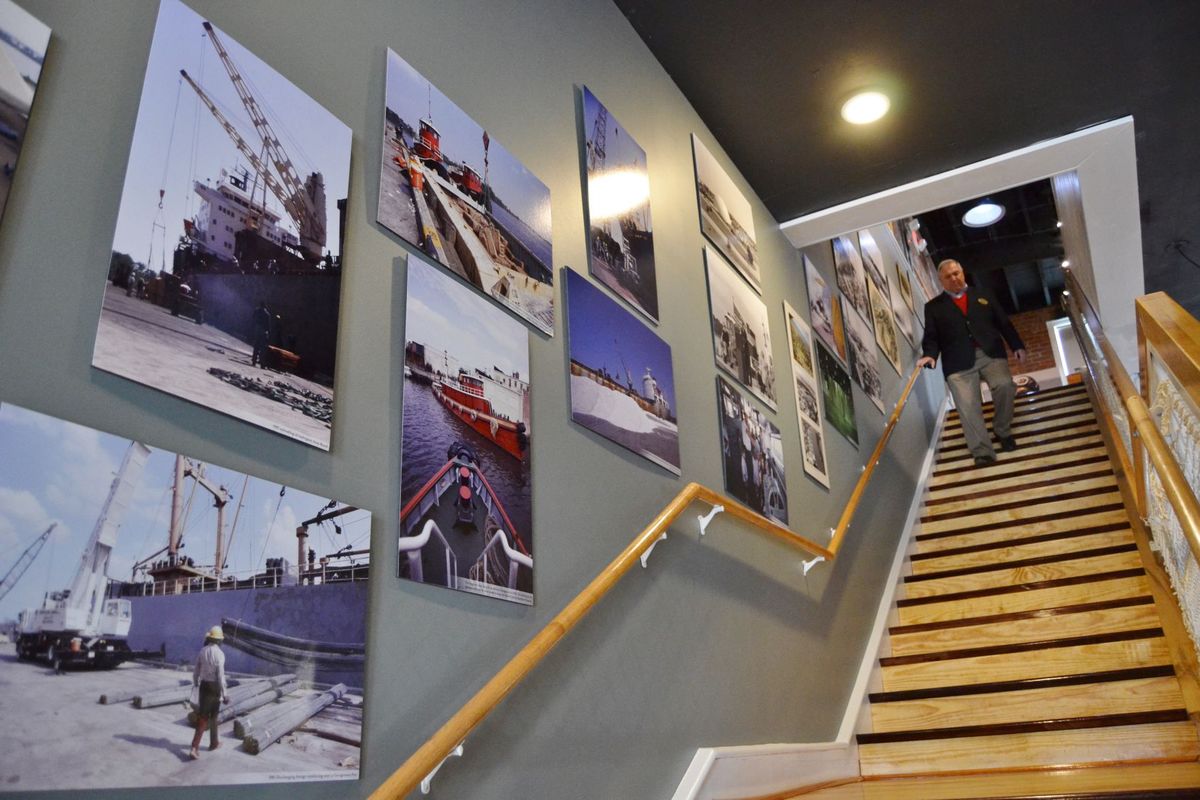
The new Lumber Schooners exhibit is a series of 26 enlarged photographs, charts, and maps that have been reproduced, courtesy of the Maine Maritime Museum and the Georgetown County Digital Library. Much of the exhibit is devoted to the City of Georgetown, a four-masted sailing schooner chartered by the Atlantic Coast Lumber Company, whose mill in Georgetown was one of the largest lumber operations in America at the time. The construction of the vessel was financed by a group of forty nine investors, nine of whom were Georgetown people.
The black-and-white and sepia photo enlargements in the exhibit depict the life story of the City of Georgetown. The 168 foot vessel was built at the William Rogers Shipyard in Bath, Maine. She had a short, but busy, life. Her maiden voyage was to Georgetown in 1902. Eleven years later, in 1913, after many voyages delivering lumber to New England shipyards, she was rammed and sunk off the Atlantic coast by the German ocean liner Prinz Oskar, though all hands were saved
Other exhibits of South Carolina maritime history will follow. It is the purpose of the South Carolina Maritime Museum to offer a variety of experiences to young people and adults by collecting, preserving and interpreting items of historical interest for educational purposes and to recount South Carolina maritime history through artifacts, documents and other materials of antique or historical value. The exhibits will further the public interest, knowledge, understanding, and appreciation of the seagoing heritage of South Carolina.
2011 Christmas Parade
The SCMM entered a float in the Georgetown Christmas Parade which was held on Saturday, December 3, 2011.
We started with this:

Susan Sanders and Don Trimble at Jeepy's warehouse.
Transformed it into this:

Queuing up for the parade.

Oh what a beautiful morning!

Hint. Hint.
And then we won this:

South Carolina Maritime Museum "Best Overall"
Maritime Museum Moving Fast

by Becky Billingsley
Just three months from the time when the South Carolina Maritime Museum committee learned of the availability of space at 729 Front St., the building’s lower level has been purchased and a crew of construction workers are working at a furious pace to have it ready for visitors at the 22nd Annual Wooden Boat Show on Oct. 15.
The museum won’t be finished by then, but its new director, Susan Sanders, says the layout will be completed enough so visitors can come in and see how it’s taking shape.
If Sanders’ name sounds familiar, it’s because she used to live in Georgetown and was a business owner here. Originally from Elizabeth City, N.C., Sanders grew up in Alexandria, Va., and graduated from the University of North Carolina at Greensboro with a degree in math. She worked for 18 years in Greensboro as a draftsman, then as a computer programmer, at a steel fabrication company before taking a 2-year leave of absence to earn a master’s degree in business at Wake Forest University.
In 1988 she and her partner, Len Anderson, decided to launch their own business and started a custom embroidery service in Oriental, N.C., called Harbor Specialties.
“Six years later we were passing through Georgetown on our way to a trade show,” Sanders said. “Georgetown had built the Harborwalk and was completing the streetscape, and we were so taken with what Georgetown was doing, we packed up and moved here for what we saw as the grand opening of the waterfront. We opened Harbor Specialties at 732 Front St., where the Rice Paddy is now, on May 1, 1993.”
During that first year Sanders and Anderson lived in Georgetown, they became friends with Sid Hood and Sally Swineford of The River Room. Hood and Anderson worked together on the Wooden Boat Show, which at the time was part of Bayfest, and by 1995 the men had created a separate event for the Wooden Boat Show.
“That was the beginning of the Harbor Historical Association,” Sanders said. “We formed a 501c3 organization, and that became the non-profit that put on the Wooden Boat Show.”
By 1996 a boat building challenge was added to the Wooden Boat Show, and that is when Sanders became involved in the festival.
“That’s when the boat show really grew, and we had to get serious about sponsors and raising some money. We had such strong community support we started making money and putting it away toward our maritime museum. We have been putting money away every year, and we really saved a substantial amount toward an opportunity to buy or invest in real estate and have a real maritime museum.”
In 1999 Sanders and Anderson moved to Charleston to open another Harbor Specialties store, and then in 2005 they relocated to Beaufort, N.C. to launch another shop. But while they were away, the couple maintained their ties and friendships in Georgetown, and remained involved in the Wooden Boat Show. When the opportunity arose for Sanders to come back to Georgetown to be the museum director, neither she nor Anderson hesitated.
They still have Harbor Specialties in Beaufort, but employees are running it. The couple, who have been together 41 years and own a Cape Dory 19 sailboat, now are living in the Fogle Building on Front Street just steps away from her new project.
Right now Sanders’ duties include overseeing building renovations. The 5,000 square- foot space, which has been unused for some 20 years, has its restrooms walled in, where vintage-looking black and white tiles are being installed. A kitchen also has its walls up, where food can be prepared for museum special events.
The new museum director is also eager to determine a fiscal budget, make a timeline for construction completion and the museum’s opening, and establish a fund-raising campaign to pay for the building’s mortgage. Sanders is also thinking about exhibits, and toward that end will be working closely with area resident, historian and boater Robert “Mac” McAlister who recently had a book published titled “Wooden Ships on Winyah Bay.”
“We’ve got so much history around the beginning of the 20th century with the logging industry and logging schooners, the birth of Georgetown and Port Royal, and the beginning of the shipping industry in South Carolina. It’s going to be the South Carolina Maritime Museum, so it will reach beyond Georgetown. There are a number of significant stories of how this whole coast became busy with indigo, rice and ship- building. In conjunction with artifacts, we’ll have stories to tell with photography and interactive exhibits. We’ll make it dynamic.”
In recent years Sanders has visited many East Coast maritime museums to gather ideas and information. Already the museum committee – basically the same dozen or so hard- working citizens who plan the Wooden Boat Show – has boat models and photographs that will become part of the exhibits. When the museum Web site is completed – SCMaritimeMuseum.org – there will be a page where people who have possible exhibit additions can fill out a form and send in photos so the items can be considered for inclusion by a screening committee.
The Web site also will have a place for donations. The goal is to have the museum open in 2012, and annual memberships start at $40 for individuals, and business memberships will range from $250 to $300. Sanders can be reached at (877) 285-3888, and anyone wishing to make a donation before the Web site is finished can mail a check made out to the SC Maritime Museum to P.O. Box 2228, Georgetown, S.C., 29442.